
'The crisis has strengthened America's resolve to work towards building its relationship with India as a bulwark against Chinese aggression'

The sources said the situation in eastern Ladakh remained 'tense' and that around 30-40 soldiers of China's People's Liberation Army (PLA) are holding up at a position close to an Indian post in the Rezang-La ridgeline in eastern Ladakh.

The use of firearms along the LAC marks a serious escalation in border tensions as the previous instance of shots being fired at the de-facto border was in 1975.
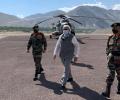
As the China factor enters the body politic of India with greater potency, its consequences will certainly be far-reaching, note Harsh V Pant and Vinay Kaura.
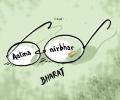
India's shift towards US companies for technology investments and partnerships fits well with the present government's 'Atmanirbhar Bharat' and 'Make in India' initiatives, say experts.

The Indian Navy has deployed a range of its frontline warships and submarines in the Indian Ocean region to send a clear message to China following the escalation of the border dispute in eastern Ladakh.

The US attacked China for its aggressive moves against its neighbours, including "instigating" a deadly confrontation with India in eastern Ladakh

Asked about the clash between Chinese and Indian soldiers at Galwan Valley in Ladakh last month, Pawar said, "When I say there should be no politics over the issue, it is because we can attack them. But the entire country will have to pay a heavy price when there is retaliation to the attack."

'It's a very tough situation. We're talking to India. We're talking to China. They've got a big problem there'

Assistant Secretary for East Asian and Pacific Affairs David Stilwell made the remark on Thursday, adding that the Trump administration is closely watching the Indo-China situation.

The talks took place in a beach resort in Benaulim on the sidelines of a meeting of the Council of Foreign Ministers of the Shanghai Cooperation Organisation.
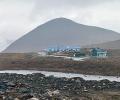
China's national legislature -- the National People's Congress (NPC) -- on October 23 adopted the new law on the protection and exploitation of the land border areas which drew sharp reaction from India as it was passed amid the protracted military standoff between the two sides in eastern Ladakh region.

Severely critical of China, Pompeo, cited killing of Indian Army personnel in the Galwan Valley in eastern Ladakh in a clash with the Chinese military, and asserted that both India and the US are taking steps to strengthen cooperation against all threats and not just those posed by the Chinese Communist Party.

Unless each attack drone can be neutralised, India will be literally deploying elephants to stamp out ants -- and the ants may still survive! points out N Sathiya Moorthy.

The answer to Chinese tactics of nibbling territory is not defence of every inch -- a military impossibility -- but instead, nibbling at Chinese territory wherever we are in a stronger position, counsels Colonel Anil A Athale (retd).

External Affairs Minister S Jaishankar said on Friday that India and China are going through a 'particularly bad patch' in their ties because Beijing has taken a set of actions in violation of agreements for which it still doesn't have a 'credible explanation' and it is for the Chinese leadership to answer where they want to take the bilateral relationship.

The Indian and Chinese armies have been locked in a bitter standoff at multiple locations in eastern Ladakh for over eight weeks since May 5.
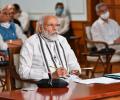
Indian forces are doing what they have to do to protect the country, whether it is in terms of deployment, action or counter-action, Modi told political leaders.

'It is nobody's contention that uncomfortable questions regarding national security should not be raised. But that is a topic for another day and another time when the immediate threat has faded,' argues Vivek Gumaste.

China has chosen to keep New Delhi guessing, while retaining for itself the option of constantly changing facts on the ground and shifting the LAC westwards -- the strategy called 'salami slicing', notes Ajai Shukla.

Thirty-one army personnel too have been awarded the Sena (gallantry) medal.

Rup Narayan Das reveals the towering Odisha leader's role in improving national security after the 1962 War with China.

The experts also said China's military 'misadventure' may have been driven in part by President Xi Jinping's attempt to show 'gains somewhere" after the growing global criticism against his country over the origin of COVID-19.

The time is ripe to extend the confrontation with the Chinese to the maritime domain, says former RA&W officer Krishan Varma.
Against the backdrop of the standoff between Indian and Chinese troops in eastern Ladakh, the White House press secy said the United States was closely monitoring the current situation and supports its peaceful resolution.
India has experienced hands and will emerge with flying colours, declares Inspector General Gurdip Singh Uban (retd).

'Nanda Devi is not an easy mountain to climb.'

In heart-wrenching scenes reminiscent of the aftermath of the 2019 Pulwama terror attack in which 40 CRPF personnel were killed, coffins of soldiers arrived in several states for the last rites with full military honours.
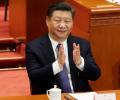
Xi ordered the military to think about worst-case scenarios, scale up training and battle preparedness, promptly and effectively deal with all sorts of complex situations and resolutely safeguard national sovereignty, security and development interests, state-run Xinhua news agency reported, without mentioning any specific issues that posed a threat to the country.

He also said it was important that even during the difficult moments of this "crisis" India has been communicating and engaging with China.
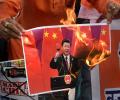
'And this mirror imaging is the most dangerous thing because it leads to tremendous misunderstandings.'

China remains in firm control of an estimated 600-800 square kilometres of Indian territory.
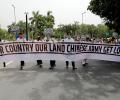
'Even those who do not like him will rally to his call if he says that the country's sovereignty is being threatened by China,' notes Aakar Patel.

India has told China that disengagement at all friction points is necessary to contemplate de-escalation of troops in eastern Ladakh even as the foreign ministers of the two countries agreed to establish a hotline for "timely" communication and exchange of views.
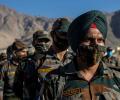
In a strong response to China's objection to development of infrastructure on the Indian side of the LAC, New Delhi also asserted that Beijing has no locus standi to comment on India's internal matters.

The stand by China spelt out by its foreign ministry insisting that it takes the 1959 line on perception of the LAC amid a nearly five-month-long border standoff in eastern Ladakh triggered a strong reaction from India.

'The Chinese -- up to the highest leadership -- will avoid a conflict because they know they will be badly licked.' 'The reputation they have painstakingly built over the last two-three decades of being a global power will be destroyed.'
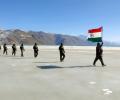
India has told China not to "shift goalposts" and "confuse" managing the border affairs and restoring peace at the frontiers with the larger issue of the resolution of the boundary question, which is dealt with by different designated mechanisms.
The decisions were mentioned in a joint statement issued by the two armies late Tuesday, a day after the sixth round of Sino-India Corps commander-level talks that lasted for 14-hours.

India-China relations have always attracted Parliament's attention and there have always been useful and productive and constructive discussions how to engage with China, notes Rup Narayan Das.
